IELTS Academic or General Training? 3 Costly Mistakes to Avoid Before You Book
Every week someone books a consultation with us after sitting the wrong version of the exam. Choosing between IELTS Academic or General Training looks like a detail until it costs you a test fee, a retake, and three months you did not have. Here is how to get it right the first time.
IELTS comes in two versions, and they are not interchangeable. Book the wrong one and you will not find out at the test centre — you will find out weeks later, when the organisation you sent your results to tells you they cannot use them.
Choosing between IELTS Academic or General Training is the first decision you make and the easiest one to get wrong, because the names suggest a difficulty ranking that does not exist.
The good news is that the decision is genuinely simple. It is not about your English level, your job, or how educated you are. It depends on one thing: who is asking for the score.
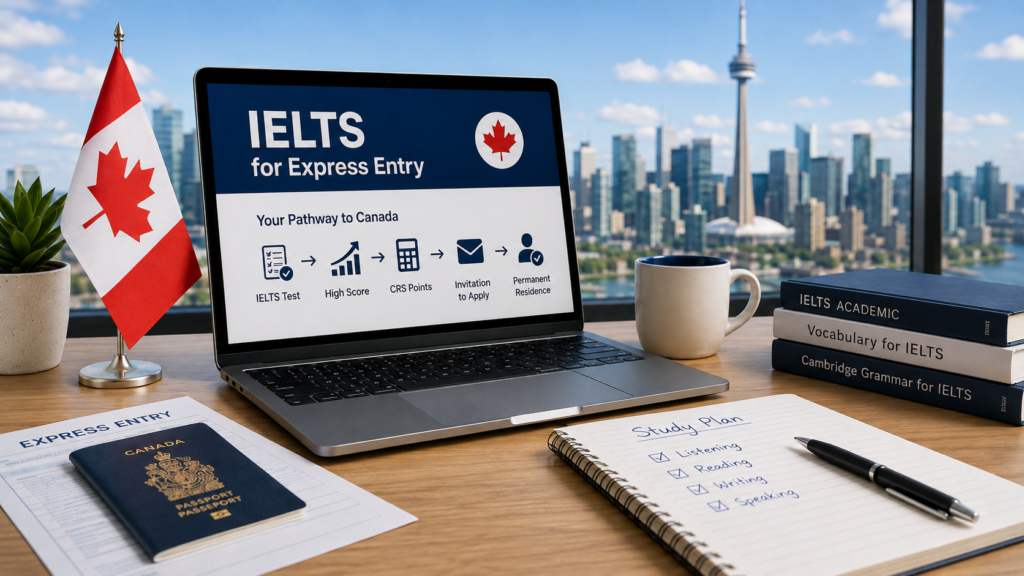
Applying for Canadian permanent residence? You need IELTS General Training. Applying to a Canadian university or college, or to a professional regulator? You almost certainly need IELTS Academic. If you need both, you will have to sit both.
If your goal is permanent residence
For Express Entry and most economic immigration streams, IRCC accepts IELTS General Training only. IELTS Academic is not accepted — and this holds regardless of your occupation, your degree, or how high you score. A Band 8 Academic result is worth exactly nothing to an Express Entry profile.
This surprises people, and the reason it surprises them is understandable. If you are a physician or an engineer, “Academic” sounds like the serious version, the one that matches your background. It is not a difficulty ranking. The two versions test different situations, and IRCC wants the one built around everyday and workplace English, because that is what settling in Canada actually involves.
IELTS General Training is not the only accepted English test — CELPIP-General is also widely used, and the list of approved tests has changed more than once in recent years. If you have not booked yet, it is worth checking the current list before you decide.
Taking IELTS Academic for an immigration application is the single most common test-booking error we see. There is no conversion, no appeal, and no partial credit. You retake the full four-skill test, pay again, and wait again — usually losing two to three months at a point in the process where timing matters most.
If your goal is study or professional licensing
Universities and colleges almost always require IELTS Academic, because the reading and writing tasks are built around the kind of material you will meet in a degree programme. The same is usually true of professional regulators — nursing, engineering, accounting and similar bodies typically ask for Academic, and often set a minimum in each individual skill rather than an overall band.
“Usually” is doing real work in that sentence. Requirements vary by institution and by profession, and some regulators accept alternatives. Check the specific programme or regulator’s own page before booking, not a general guide — including this one.
What actually differs between the two
Half the test is identical. Listening and Speaking are exactly the same in both versions — same format, same tasks, same marking. Everything that differs sits in Reading and Writing.
| Section | General Training | Academic |
|---|---|---|
| Listening | Identical in both versions | |
| Speaking | Identical in both versions | |
| Reading | Notices, advertisements, workplace documents, and one longer general-interest text | Three long passages from journals, books and reports, on academic subjects |
| Writing Task 1 | A letter — formal, semi-formal or personal, depending on the prompt | A description of a chart, graph, table, map or process |
| Writing Task 2 | An essay. Prompts tend to be more everyday in subject matter | An essay. Prompts tend to be more abstract or academic |
One detail worth knowing: General Training Reading is marked on a stricter curve. The texts are easier, so you need more correct answers to reach the same band. Candidates who assume General Training is “the easy one” and prepare casually are the ones most often caught out by this.
Writing Task 1 is the other place people underestimate the gap. A letter and a chart description are completely different skills. Practising one prepares you almost not at all for the other, so material aimed at the wrong version is close to wasted time. If Writing is where you are weakest, our IELTS Writing Analysis marks a real submission against the official criteria, and the free Thursday workshop covers Task 2 at no cost.
Choosing in one minute
- Applying through Express Entry
- Applying to a provincial nominee programme
- Sponsoring or being sponsored by family
- Asked for proof of English for most work or settlement purposes
- Applying to a Canadian university or college
- Applying for a study permit that names Academic
- Registering with a professional regulator
- Asked for it by name by the organisation receiving your score
3 costly mistakes to avoid before you book
- Mistake 1: trusting anyone but the receiving organisation. Not an agent, not a forum, not a blog — including this one. The body that will read your score is the only one whose answer counts.
- Mistake 2: forgetting the expiry date. For immigration purposes results are generally valid for two years, and they must still be valid when you submit — not merely when you first apply. People lose applications to expiry more often than to low scores.
- Mistake 3: banking on a single-skill retake. Partial retake options exist, but they are not accepted everywhere. Confirm your receiving body will take one before you rely on it, or you may end up sitting all four skills again anyway.
The bottom line
Pick the version your destination asks for, not the one that sounds more impressive. Then prepare for that version specifically — because the half of the test that differs is precisely the half most people find hardest.
Once you have settled IELTS Academic or General Training, the next question is what score you actually need. If you are applying through Express Entry, our guide to the IELTS score for Express Entry covers the full CLB conversion table, what CLB 9 is worth in CRS points, and the seven mistakes that cost candidates most.
If you are still unsure which one applies to your situation, that is a five-minute conversation, and it is worth having before you pay a test fee — a free consultation will settle it.
Verify before you book. Language-test rules change, and the list of accepted tests has been updated more than once in recent years. Confirm current requirements on the official Immigration, Refugees and Citizenship Canada site, or with the university or regulator receiving your score. This article was last reviewed on 4 August 2026 and is general information, not immigration advice.
Know which test you need. Now get the score.
Our IELTS Intensive runs one skill at a time over two weeks — live classes, two marked mock exams, and a private 1-on-1. Academic and General Training both supported.