IELTS Score for Express Entry: 7 Costly Mistakes That Sink Your CRS Points
Language is the biggest block of points you personally control in Express Entry — worth up to 136 for a single applicant, before the bonus points it unlocks. Most candidates leave some of it on the table without ever realising it.
Almost everything in an Express Entry profile is fixed by the time you apply. Your age only moves in one direction. Your degree is already earned. Your work history is what it is. There is exactly one large block of points you can still change by deciding to, and that is language — which is why your IELTS score for Express Entry deserves more planning than most candidates give it.
Which is why getting your IELTS score for Express Entry right is worth more attention than most candidates give it. Not just clearing the minimum — understanding how bands convert, where the point jumps sit, and which of the four skills quietly decides your outcome.
Below are the seven mistakes we see most often. Some cost a handful of points. One of them costs the entire test.
Your IELTS bands earn you nothing directly. IRCC converts each band into a Canadian Language Benchmark (CLB) level, skill by skill, and awards points on the CLB. Every decision about your IELTS score for Express Entry should be made by looking at the conversion table, not at your band certificate.
1Taking IELTS Academic
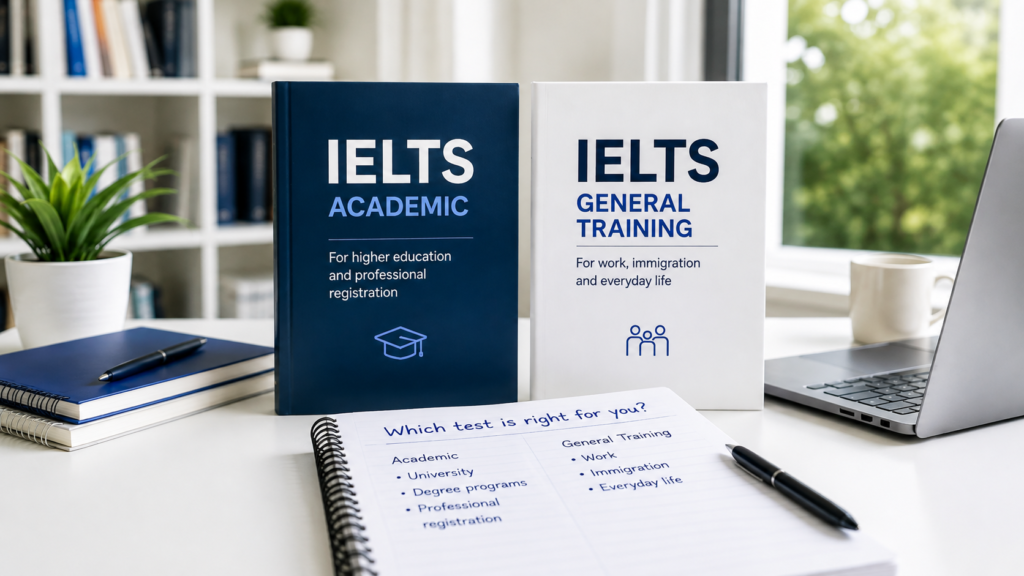
This is the expensive one, and it is still the most common. For Express Entry, IRCC accepts IELTS General Training only. Academic results are not converted, not partially credited, and not appealable. A Band 8 Academic result contributes nothing to your profile.
The confusion is understandable. If you are a physician or an engineer, “Academic” sounds like the version that matches your background. It is not a difficulty ranking — the two versions test different situations, and IRCC wants the one built around everyday and workplace English, because that is what settling in Canada actually involves.
The cost is not just the test fee. It is another booking, another wait for results, and typically two to three months lost at the exact point in the process where timing matters most. If you are unsure which version applies to you, our earlier guide on IELTS Academic versus General Training walks through it in detail.
2Reading your overall band instead of the conversion table
IELTS gives you an overall band. Express Entry ignores it completely.
IRCC converts each of your four skills independently, and the conversion is not the same across skills. A 7.0 in Reading reaches CLB 9. A 7.0 in Listening does not — Listening needs an 8.0 for the same level. Candidates who assume a uniform relationship routinely miscalculate their standing by an entire CLB band.
Here is the full conversion for IELTS General Training. This table is the single most useful thing on this page:
| CLB Level | Listening | Reading | Writing | Speaking |
|---|---|---|---|---|
| CLB 10+ | 8.5 | 8.0 | 7.5 | 7.5 |
| CLB 9 | 8.0 | 7.0 | 7.0 | 7.0 |
| CLB 8 | 7.5 | 6.5 | 6.5 | 6.5 |
| CLB 7 | 6.0 | 6.0 | 6.0 | 6.0 |
| CLB 6 | 5.5 | 5.0 | 5.5 | 5.5 |
| CLB 5 | 5.0 | 4.0 | 5.0 | 5.0 |
| CLB 4 | 4.5 | 3.5 | 4.0 | 4.0 |
Minimum IELTS General Training band required to reach each CLB level, per skill. The two highlighted rows are the ones that decide most applications. A band between two listed values keeps the lower CLB.
Read that table skill by skill, write down four CLB numbers, and you have your actual position. Everything that follows depends on those four numbers rather than on your overall band.
3Aiming for the minimum instead of the threshold that pays
CLB 7 is the eligibility floor for the Federal Skilled Worker programme and for the Canadian Experience Class at NOC TEER 0 or 1. Hitting it feels like success. It is only permission to enter the queue.
The points tell a different story. For a single applicant with no spouse, first official language is scored per skill:
| CLB Level | Points per skill | Total (4 skills) | Gained vs CLB 7 |
|---|---|---|---|
| CLB 7 | 17 | 68 | — |
| CLB 8 | 23 | 92 | +24 |
| CLB 9 | 31 | 124 | +56 |
| CLB 10+ | 34 | 136 | +68 |
CRS language points for a single applicant, first official language. Figures are lower per skill for applicants with an accompanying spouse or partner, who is then scored separately.
Moving from CLB 7 to CLB 9 is worth 56 points on language alone. In IELTS terms that is Listening 6.0 to 8.0, and Reading, Writing and Speaking each 6.0 to 7.0. Demanding — but it is two weeks of focused work per skill rather than a change of career.
And 56 is the conservative figure. CLB 9 also unlocks the skill transferability categories, where language combines with your education and work experience for up to 50 additional points. Depending on your profile, the real gap between CLB 7 and CLB 9 can approach 100 CRS points. Against draw cut-offs that have sat in the high 400s for years, that is frequently the difference between an invitation and another six months of waiting.
CLB 9. It is the threshold where language points peak in value and skill transferability opens up. If you are planning an IELTS score for Express Entry, plan for CLB 9 and treat CLB 7 as the fallback, not the target.
4Forgetting that your weakest skill sets your benchmark
Eligibility and scoring work differently, and mixing them up leads people to badly misjudge where they stand.
For eligibility, your lowest skill governs. Three skills at CLB 9 and one at CLB 7 means you meet CLB 7, full stop. The strong skills do not lift the weak one.
For points, each skill is scored on its own converted level. So a weak skill hurts you twice: it drags your eligibility benchmark down, and it costs you points directly.
The practical consequence is that improvement effort should almost never be spread evenly. Take a candidate sitting at Listening 8.0, Reading 7.0, Writing 6.5, Speaking 7.0 — three skills at CLB 9, Writing at CLB 8. Their benchmark is CLB 8. Half a band in Writing, and one skill alone, moves the whole profile to CLB 9 and adds 8 language points plus whatever skill transferability opens up.
Practising all four equally would be the worst possible use of that candidate’s time.
5Assuming the four skills are equally difficult to convert
They are not, and knowing which is which changes where you spend your preparation.
- Reading converts generously. At every level it needs the lowest band. CLB 5 needs only Reading 4.0, against 5.0 for the other three. At CLB 9 you need 7.0 in Reading but 8.0 in Listening.
- Listening is unforgiving. It demands the highest band at every level from CLB 7 upward. CLB 9 requires 8.0, which in practice means missing only a handful of questions across the whole paper. CLB 10 requires 8.5.
- Writing and Speaking move in lockstep. They share identical thresholds all the way up the table. If your Speaking is weak, your Writing almost certainly needs to carry the profile, and the reverse holds too.
Most candidates plan an IELTS score for Express Entry as though Listening is the easy one, because it feels easy in practice tests. The conversion table says otherwise. Under Express Entry rules, Listening is the hardest skill to convert well and typically deserves the most preparation.
6Letting your results expire mid-application
Language test results are valid for two years for immigration purposes, and they must still be valid at the moment you submit — not merely when you first create your profile.
This catches more people than low scores do. A candidate tests, builds a profile, waits for a draw, receives an invitation eleven months later, and then discovers their results expire during the application window. There is no extension and no grace period. You retake the full test, at speed, under pressure.
If your results are more than roughly eighteen months old and you are still in the pool, plan a retake before the calendar makes the decision for you. Retaking while your existing score still stands is also strictly better than retaking after it lapses: you keep the floor you already have.
Note your test date and your expiry date somewhere you will actually see them. The failure mode is not forgetting the test — it is forgetting the expiry while you wait for a draw.
7Counting on a single-skill retake to rescue you
IELTS offers a One Skill Retake in many centres, letting you re-sit a single component rather than the whole test. It is attractive, cheaper, and faster — and for immigration purposes it may not be accepted.
Reporting indicates IRCC does not accept One Skill Retake results for Express Entry, which would mean a single-skill improvement leaves your profile unchanged. Because this is the kind of rule that changes, do not take our word for it and do not take a test centre’s word for it either. Confirm on IRCC’s own pages before you book, and treat the full four-skill retake as your default plan.
The strategic point stands regardless. If you are relying on rescuing one weak skill later, you are building a plan around an option that may not exist. Prepare so the first sitting is the one that counts.
How to plan your IELTS score for Express Entry
Pulling the seven together into a sequence:
- Book General Training. Confirm it on the booking screen before paying. This one error costs more than the other six combined.
- Set CLB 9 as the target. Listening 8.0, Reading 7.0, Writing 7.0, Speaking 7.0. Write those four numbers down and work toward them specifically.
- Take a diagnostic, then convert it. Get honest band estimates in all four skills, run them through the table above, and find your weakest CLB. A free consultation is one way to get that assessment without guessing.
- Attack the weakest skill first. Not the one you enjoy — the one setting your benchmark. The IELTS Intensive is built around exactly this: one skill at a time, over two weeks.
- Give Listening the respect it needs. The 8.0 requirement at CLB 9 is the steepest single climb in the table.
- Watch the two-year clock from the day results are issued, not from the day you enter the pool.
- Plan for one full sitting that counts, rather than a partial fix afterwards.
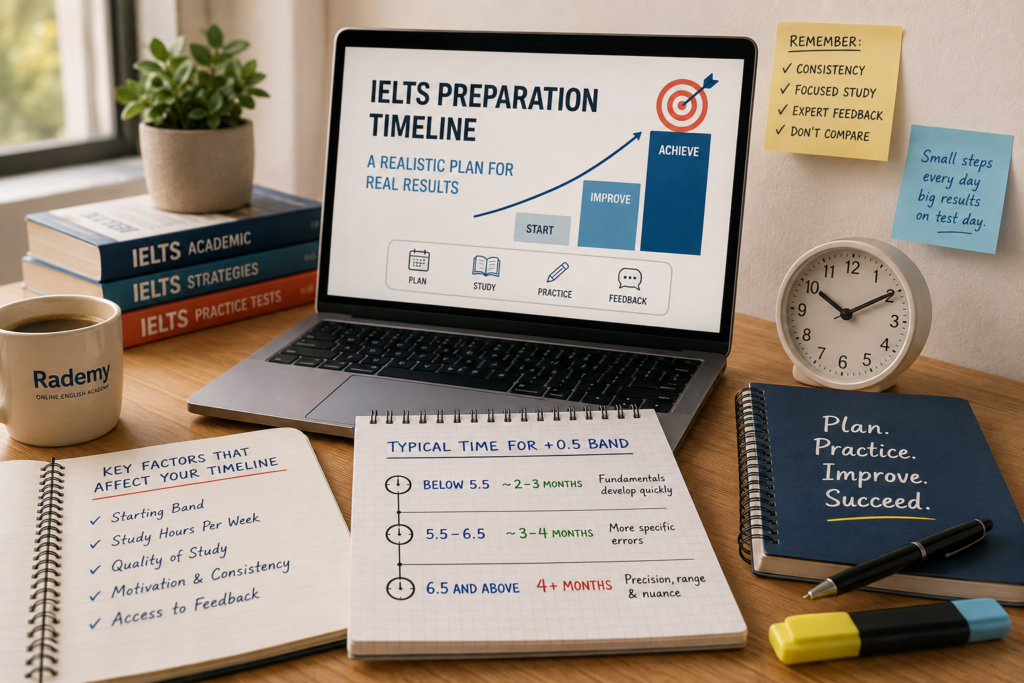
How long does one CLB level actually take?
This is the question that decides whether any of the above is worth acting on, and the honest answer is that it depends far more on which skill you are moving than on how far you are moving it.
Reading and Listening respond quickly to technique. A large share of the marks candidates lose in these papers go to timing, question-type traps and transfer errors rather than to comprehension. Someone who genuinely understands the passages but keeps running out of time can often gain half a band in a fortnight, because the underlying ability is already there and only the exam mechanics are missing.
Writing and Speaking behave differently. They are marked against band descriptors by a human examiner, and a half-band gain means measurably changing what you produce — a wider range of structures, more precise vocabulary, better-controlled task response. That is slower, and it is close to impossible without someone marking your work against the actual criteria and telling you which descriptor is holding you at your current band. Self-study plateaus here more than anywhere else, because you cannot see your own errors clearly enough to fix them. If you want a read on where your Writing actually sits, our IELTS Writing Analysis returns a band estimate and a written breakdown against the official criteria.
The practical implication for anyone planning an IELTS score for Express Entry: if your gap is in Reading or Listening, disciplined solo practice with real past papers may well close it. If your gap is in Writing or Speaking, budget for feedback. It is the difference between knowing you scored 6.5 and knowing precisely why. Our free IELTS workshop runs every Thursday and covers Writing Task 2 specifically, which is a reasonable place to start at no cost.
A worked example
Consider a candidate who sits IELTS General Training and scores Listening 7.5, Reading 7.0, Writing 6.5, Speaking 7.0. Converted: Listening CLB 8, Reading CLB 9, Writing CLB 8, Speaking CLB 9. Benchmark CLB 8. Language points: 23 + 31 + 23 + 31 = 108.
Two skills sit half a band below CLB 9 — Listening needs 8.0 and Writing needs 7.0. Closing both moves all four skills to CLB 9: 124 points, a gain of 16, plus whatever skill transferability their education and experience now unlock.
That is half a band in two skills. For most candidates it is a fortnight of targeted work, not a year — our Band 6 to 7 Writing guide covers what that half-band actually requires in Writing. This is the shape of the opportunity that most people miss when planning an IELTS score for Express Entry: the gap between where you are and where the points are is usually smaller than it looks, and it is almost never spread evenly across the four skills.
The bottom line
Language is the one substantial block of CRS points still under your control on the day you decide to act. Take the right version of the test, read the conversion table skill by skill, aim at CLB 9 rather than at the floor, and put your preparation where your weakest skill is.
Do those four things and your IELTS score for Express Entry will do more work for your profile than any other single decision available to you.
Verify before you book or submit. Conversion tables, point values and accepted tests are set by IRCC and do change. Confirm current requirements on the official Immigration, Refugees and Citizenship Canada site before making decisions. This article was last reviewed on 4 August 2026 and is general information, not immigration advice.
Know your target. Now hit it.
Our IELTS Intensive takes one skill at a time over two weeks — live small-group classes, two marked mock exams, and a private 1-on-1. Built for candidates who need a specific band, not general practice.